|
Hospitalization |
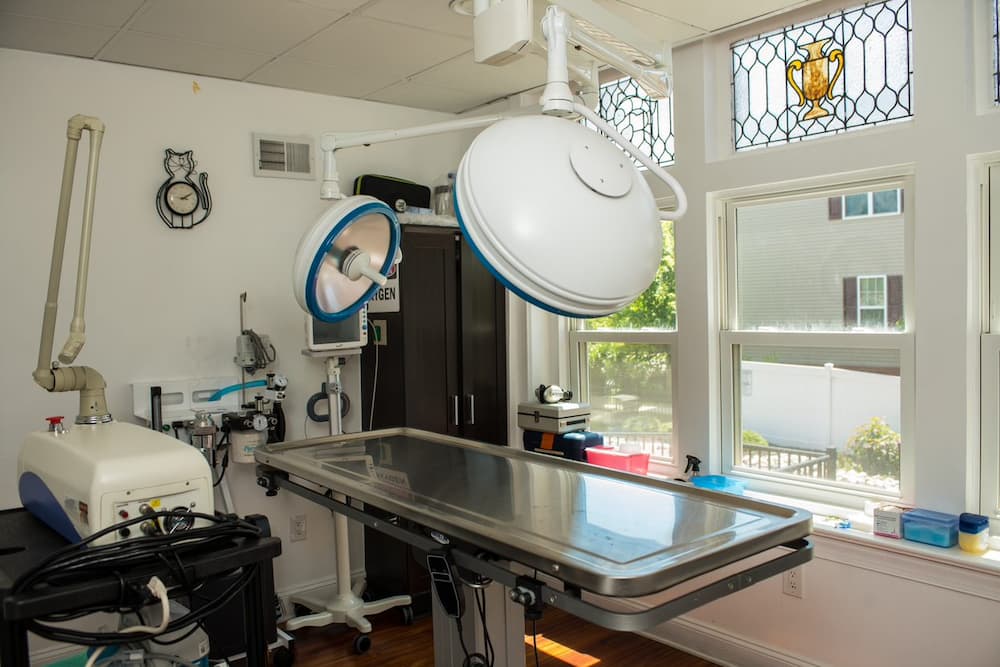
In some instances, we may recommend
hospitalization for your cat. Our hospital
is equipped with a number of monitoring
equipment and services. The following is
a short list of services and equipment that
may be required:
- IV (intravenous) fluids / IV pumps – Having direct access to a vein allows continuous fluid supportive care to be administered. An IV catheter also allows our doctors to administer many medications (i.e. antibiotics, pain medications) directly into the vein. IV catheters are also placed in all patients undergoing a surgical procedure.
- In-house pharmacy – Our in-house pharmacy provides the necessary medications to treat your cat, especially when they suddenly become unwell.
- In-house laboratory – Our in-house laboratory allows our doctors to get results fast when time is of the essence. We are able to obtain results for common blood and urine tests and provide our patients with appropriate monitoring while they are hospitalized.
- Radiographs (x-rays)
- Ultrasound
- Blood pressure measurements
- Pulse oximetry – determines blood oxygen levels
- Glucometer –determines blood glucose (sugar) levels
Since your cat is away from home, we strive to provide your cat with a comfortable environment during their stay with us. We understand that these are stressful times for both you and your cat. Each of our patients is given a comfortable bed to relax in our quiet, calm environment. You are encouraged to bring your cat’s favorite toy, dish, or blanket to make them feel as comfortable as possible. We encourage you to visit as well and our doctors will contact you daily about the status of your cat. Please do not hesitate to contact us for an update!
Radiographs (X-rays)
Radiographs (x-rays) allows our doctors to
view internal structures of your cat and is
an important component of a diagnostic
work-up. Often times, we like to couple a
comprehensive blood panel with some
images (x-rays) to fully evaluate a body
system that is in question. Our doctors will discuss each radiograph (x-ray) with you and point out the normal anatomy and any abnormalities that are present. A brief description of the most common radiographs (x-rays) is given below. Other views may be taken such as limbs, head and neck.
Abdominal radiographs (x-rays) aid our doctors in evaluating your cat’s internal organs (i.e. liver, digestive tract (stomach, intestine, colon), kidneys, spleen, bladder). With this radiograph (x-ray), each organ is evaluated for size, shape, location, relationships to other organs, and the presence of any abnormalities or disease. Radiographs (x-rays) may be taken to establish a baseline and monitor changes in the future.
Thoracic (chest) radiographs (x-rays) aid our doctors in evaluating your cat’s heart and lungs. With this radiograph (x-rays), the heart, lungs, vessels, ribs, and spine are evaluated for size, shape, location, relationships to other organs, and the presence of any abnormalities or disease.
Senior radiographic (x-rays) screening helps our doctors detect and monitor for common ailments seen in our older cats such as arthritis and cancer. We recommend that all cats over the age of 8 years have screening x-rays prior to anesthesia.
Ultrasound
This non-invasive diagnostic tool allows our doctors to image your cat’s internal organs to give us specific and detailed information on an internal organ. Often times, radiographs (x-rays) and ultrasound are taken together to obtain a complete picture of your cat. Radiographs (x-rays) allow our doctors to view all of the internal organs together in one picture. An ultrasound allows our doctors to specifically focus on one organ at a time and obtain very detailed information on that organ. Organs that are evaluated include the liver, gall bladder, digestive tract (stomach, intestines, colon), spleen, pancreas, adrenal glands, lymph nodes and urinary bladder. Together with a comprehensive blood panel, a great deal of information is obtained to formulate a more specific and appropriate medical plan for your cat.
|
|
|
 |
 |
Monday
Tuesday
Wednesday
Thursday
Friday
Saturday
Sunday |
7:30 a – 8 p
7:30 a – 8 p
7:30 a – 8 p
7:30 a – 8 p
7:30 a – 8 p
8:30 a – 1 p
Closed |
|
|
|
 |
|